| Print |
Operational review BIDVEST OFFICE
 |
|
| The division is a leading distributor of office products, stationery, office furniture, office automation and related technology. Bidvest Office represents some of the strongest brands in its sector, including Konica Minolta, Océ, Waltons, Hortors, Cecil Nurse Business Furniture, Dauphin, Pago and Global Payment Technologies. The business’s product bouquet comprises sector leaders such as bizhub, océ and Konica Minolta Medical Imaging. Waltons has served South Africa since 1949 and is the largest office products distributor in Southern Africa while Cecil Nurse is one of the most respected names in office furniture. The division is known for constant innovation, bringing niche digital X-Ray technology to South Africa while giving a ‘green lead’ by reducing the environmental impacts of its products. |
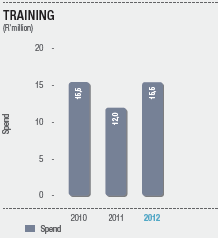
“Training investment rose to R15,5 million (2011: R12,0 million). The division’s highly trained people contribute to competitive advantage, especially in the office
technology market Alan Griffith
|
||
|
Financial performance
Environmental performance
Social performance
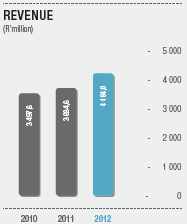
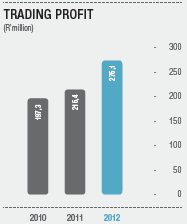
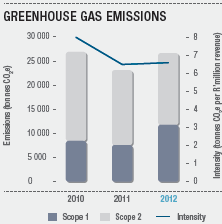
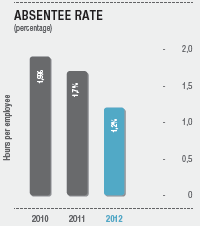
Nature of businessThe nationally represented business is a leading supplier of office products, including stationery, furniture, office automation and cash handling solutions. Key contributors are: Konica Minolta, Océ, Global Payment Technologies (GPT), Waltons, Hortors, SA Diaries, Cecil Nurse Business Furniture, Dauphin Human Design (office furniture), Pago Designs, BidOffice Furniture Manufacturing, Seating and Ditulo. They are housed in three sub-divisions: technology, stationery and furniture. Material issues and business risksStationery benefits from the fundamental nature of its core products and consistent demand for these consumables. Furniture is subject to cyclical fluctuations as replacement intervals can be extended by corporates pursuing expense savings. Imports, both low-cost and up-market, impact the business. Technology draws advantage from short replacement cycles as early adoption of new technology contributes to business efficiency. South Africa’s limited supply of skilled labour (notably engineers and technicians) creates challenges. Procurement practice creates risks and opportunities. Empowerment status can affect a supplier’s ability to compete while ‘green’ credentials have become vital for those supplying major corporates. Environmental focus is a source of competitive advantage as the division supplies products from world technology leaders that give a ‘green edge’. A major technology trend – convergence and integration – creates opportunities to supply new products and services to major institutions and companies. Rises in electricity prices and greater efforts by big business to monitor electricity consumption create marketing opportunities as advanced office automation technology incorporates consumption calculators. These smart machines can prove they are less expensive to run than older equipment. Rand performance against the yen can affect financial performance as many high-tech products are sourced from Japan. The business represents world technology leaders. Loss of a brand principal would have significant impact. Conversely, a reputation for quality local representation of big-name brands can attract the attention of prospective international entrants to the local market, creating opportunities to expand the agency portfolio. Competitive activity is intense in all areas of business. Performance and trading conditionsRevenue rose 13,6% to R4,2 billion (2011: R3,7 billion), with trading profit 27,7% higher at R275,1 million (2011: R215,4 million). Profit was favourably impacted by an increase in overall margin to 6,6% (2011: 5,8%) on the back of intense competition ameliorated by cost savings. Yen strength was negative. At 44,2% (2011: 32,8%) ROFE was much improved as a result of increased profitability with virtually no increase in capital employed.All teams enjoyed significant success with expense management, but results were impacted by an exceptional charge of R23,4 million in closure and retrenchment costs. There were no acquisitions and no business disposals. Capital expenditure totalled R55,9 million. The division saw a net loss of 72 jobs, taking the staff complement to 4 169. There was, however, a growth in jobs in the high-tech areas. Waltons was rationalised to increase the focus on commercial and corporate stationery. Ten retail stores were closed and 137 staff retrenched. The model for the new metropolitan face of Waltons was launched with the opening of the chain’s Durban distribution centre. Four Durban branches were integrated into the operation. The same model will be adopted in Cape Town in the coming year. The integration of all manufacturing into a single operating unit was completed. Work will continue to unlock further efficiencies. No permanent jobs were lost. Highs and lowsThough several businesses were rationalised and expenses taken out the business, staff motivation remained high. Good morale drove a highly pleasing performance. The only disappointment was in furniture manufacturing where efficiencies flowing from the restructure failed to materialise in the envisaged timeframe. Other furniture operations performed at a reasonable level. In recent years cheap office furniture imports have sharpened the competitive challenge, but a trend to local sourcing became apparent in 2012. Konica Minolta entrenched its position via the Bizhub brand as South Africa’s top office automation brand. Konica Minolta and Océ optimised the trend to short-run digital printing across medium and big business by establishing themselves as the top two suppliers in this sector. A tipping point was reached in the local market for integrated office automation solutions when Konica Minolta completed a major installation at the University of Johannesburg. The contract called for the integration of intelligent office systems governing paper-flows, archiving, retrieval and reporting. Divisional staff manage the system on site for the client. A similar solution is being adopted at the premises of a major automotive manufacturer. A sustainable businessThe business entrenched its reputation for environmental sensitivity. New X-ray technology from Konica Minolta Medical reduces radiation dosage. Almost all the division’s digital equipment uses polymerised toners with a plant base that poses no environmental or health risks. Most black and white devices from Konica Minolta use a built-in toner recycling system that saves toner for re-use, cuts toner consumption and reduces carbon emissions. The division uses a recycling system when replacing end-of-life equipment and assists customers in the responsible disposal of cartridges and toner bottles. Research and development focuses on potential uses for recycled and recyclable material on the pattern pioneered by Seating’s Form Chair (the ‘green chair’). The 95% recyclable chair retained its position as chair of choice for corporates that demand environmentally sensitive solutions. Sustainability champions are active across the division. Risk and sustainability committees convene every quarter and ensure accurate tracking of key benchmarks such as the carbon footprint. Staff members have become enviro-warriors. They run initiatives to limit environmental impacts and foster recycling. They drive tree-planting programmes, not only close to their home base but in rural areas. The goal is not only to achieve carbon neutrality through off-sets like this but to reduce the carbon footprint – a challenge at a growing business. Fuel consumption increased in 2012 due to business expansion. Environmental sensitivity is built into the CSI programme and CSI spend increased by 14,0% to R3,1 million. The division supports the World Wildlife Fund Rhino DNA Index System or RhoDIS project. Project teams have developed a DNA profiling technique that can identify individual rhino horns. Teams sample rhino across Africa (and soon Asia) so seized horn can be traced to specific poaching incidents. This helps combat poaching by making it easier to prosecute poachers. A donation is made to the project every time a Konica Minolta Bizhub is sold. The business also partners The Edu-Care Foundation. At year-end the division donated a mobile library to the NGO for deployment into disadvantaged areas in and around Johannesburg. The division liaised with other Bidvest businesses to source, customise, insure and equip the vehicle at competitive rates. The library on wheels goes into service early in the new period. GPT’s partnership with Conquest for Life entered its second year. The intervention teaches life skills to disadvantaged Gauteng children. To date the project has assisted over 500 children. StakeholdersStakeholders include staff members, unions, customers, suppliers, shareholders and communities. Decentralised businesses ensure interaction is local and continual. Communication is through magazines, newsletters and word of mouth, often at one-on-one meetings. Staff communication is assisted by management’s open-door policy and good relationships with trade unions. Staff development, performance management and career pathing are focus areas. Developmental goals are set in individual meetings. Pay incentives encourage not only performance improvements on the job but educational progress. Movement to higher pay grades may be contingent on the completion of specified courses. Training investment rose to R15,5 million (2011: R12,0 million). The division’s highly trained people contribute to competitive advantage, especially in the office technology market. Brand principals insist their products are supported by qualified personnel and may assist in training, either by hosting divisional personnel at international courses or by sending trainers to South Africa. Training was stepped up at GPT ahead of the launch of new mobile solutions. Upskilling and re-skilling programmes were launched at Waltons to ensure continued levels of high performance at the refocused business. The division achieved Level 3 empowerment status, though a dip to Level 4 may apply following the recalibration of targets in BEE’s second five-year phase. Waltons is at Level 2, GPT and Ocè at Level 3. Progression of black staff into middle management remains a challenge. The division has many loyal, long-serving staff members. This assures continuity, but inhibits fast-tracking of young black candidates. Upskilling of candidates into technical roles can also be time-consuming. The absentee rate has declined over the past three years to 1,15%. IT progressionTechnology investment is constant, with strong focus on system integration. Another focus area is supply chain optimisation. Waltons KZN has invested in a new warehousing management system to deliver routing and delivery efficiencies. Results so far are encouraging, paving the way for national rollout. Mobile technology is being harnessed to improve the time efficiency of support technicians. The GPS-based system enables the tracking of technical staff called out by customers and their redeployment on the go, cutting travel time and needless trips. The system plugs directly into the parts inventory to accelerate the requisitioning of stock while eliminating paper-flow. FutureThe challenge is to maintain momentum off the current high base. Trading conditions are expected to remain extremely competitive. Even so, the priority will be to restore gross margins and achieve renewed revenue and earnings growth. The stationery field has been consolidated to focus on proven winners and the Waltons image has been refreshed. Service levels are being stepped up following retraining. The new metropolitan model (first in Durban, soon in Cape Town) will help drive growth. Several new furniture ranges are being introduced. Many corporates have delayed investment in new furniture in recent years, suggesting pent-up demand. Marketing efforts will be redoubled. New product introductions are constant in the office technology field. Integration creates further opportunities. Relationships with IT partners will be explored to help drive the transition from standalone to integrated solutions. Additions to the product and services mix at GPT are imminent. Provision of deposit boxes and cash recyclers remains the core business, but expansion is envisaged into the ‘mobile wallet’ product set (money transfers through smart phone technology). Long-term opportunities are also apparent. Brands in developed countries increasingly see Africa as a growth market and regard South Africa as a platform into the continent. Foreign players look for reliable South African partners with appropriate technology skills. The opportunity to grow our ‘brand basket’ will not be neglected. |